| loading components....
[55K :: 14sec :: 33.6modem] |
| loading components....
[55K :: 14sec :: 33.6modem] |
../de_codifications/systemic_organization.html
One of the preliminary questions here is the logics of spatial organizing and the possible gaps between the anatomical and the molecular/genetic. The gradient from the anthropomorphic-corporeal body to genetic code is one of the primary analytical assumptions which informs both contemporary anatomy and genetics textbooks, and it serves as a relational and differentiating function between these scientific practices. It is especially this differentiating character, along the assumed gradient from the macro- to the micro-biological, that these two significantly distinct modes of logic with respect to the body become more prominent.


The question here is twofold: What are different logics or modes of knowledge-production by which molecular biology (in contrast to anatomy and physiology) approaches and organizes some object termed "the body"? Secondly, as a socially-embedded science with complex histories, how do specific forms of the body-language relationship (forms of textualization, taxonomic fragmentation, complex sign systems) contribute not only to the reproduction of scientific praxis itself, but also to the production of discrete units relating to the subject as a body? The first question primarily has to do with the ways in which a particular scientific practice maps out its terrain of research, establishing the issues, conceptual nodes, and problems that will be of concern. The second question has to do with the methodologies, techniques, and technologies involved in the processes of research, development, and practical (that is, medical and/or commercial) implementation.
../de_codifications/body_textuality.html
The particular mode of textualization within genetics is qualitatively different from the constructivist logics of anatomical science. Working from the molecular level, the body as a whole or in parts is not an explicit part of the epistemology of genetic research. Classical and contemporary genetics does not so much anatomize the microbiological body, as they are concerned with the processes whereby the body on the biochemical and microbiological level is regulated, produced, and maintained as a series of information-transmission patterns. If the cell forms the essential unit of composition of the anatomical body, DNA does not analogously compose the genetic body.
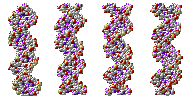
The genetic code - the particular sequence of nitrogenous bases which twist and turn to help form a given chromosome - is a linearly-arranged, complementary (Adenine always binds to Thymine, Guanine to Cytosine), "DNA text" based almost entirely on differential relationships. The letters which geneticists use to signify the sequence of bases (A for Adenine, T for Thymine, G for Guanine, C for Cytosine) form a combinatorial series which provides a blueprint for the production of a variety of amino acids (which, when chained together, form the structural and biochemical "building blocks" of proteins). When geneticists speak of a genetic code, most often what is referred to is the relationship between a given sequence unit and the production of an amino acid.
However, it is not exactly accurate to use linguistic or "text"-related tropes in discussing the genetic code, since DNA does not, strictly speaking, have a grammar. This non-grammatical textuality of DNA has undergone (and is undergoing) several changes since Mendel's experiments with plant hybrids in the early part of the century. Most notably, it was James Watson and Francis Crick's research during the 1950s on the structure and mechanics of DNA that helped to establish the specific "coding" character of genetic material. Watson and Crick explicitly made reference to the notion of "genetic information" rather than linguistic signs or a molecular linguistics.
Yet, as many historians of science point out, this conception of DNA was fairly enclosed; DNA at this point (what physicist Erwin Schroedinger had earlier dubbed the "master molecule") constituted a highly centralized, hierarchical information-operation distribution point which ran linearly from the genetic code to the processes it activated for protein production. In an extension of classical genetics, Watson and Crick's model concerned itself with the transmission of units of genetic information, within the cellular processes of an organism as well as across generations of organisms. As a molecular structure based almost entirely on a multiplicity of differential, combinatorial relationships, the genetic "code" was more closely aligned metaphorically with the notion of data or information established by classical information theory and cybernetics.
Welcome to Axys, a biopharmaceutical company pioneering a new standard for drug discovery. Axys scientists begin with the fundamentals of human biology, identifying critical genes involved in disease and selecting targets in the disease pathway for intervention. Researchers screen huge libraries of molecules to find potential drugs to attack these targets and use computer-based, "virtual" drug design to refine the drugs. Integrating all of the tools of modern biotechnology, Axys is pioneering the effort to bring innovative medicine to the world faster and more cost effectively.


   | ||||
        |   | |||
    | ||||
 | | |||
| ||||
| ||||